
📅 April 23, 2026 ⏱️11:00AM
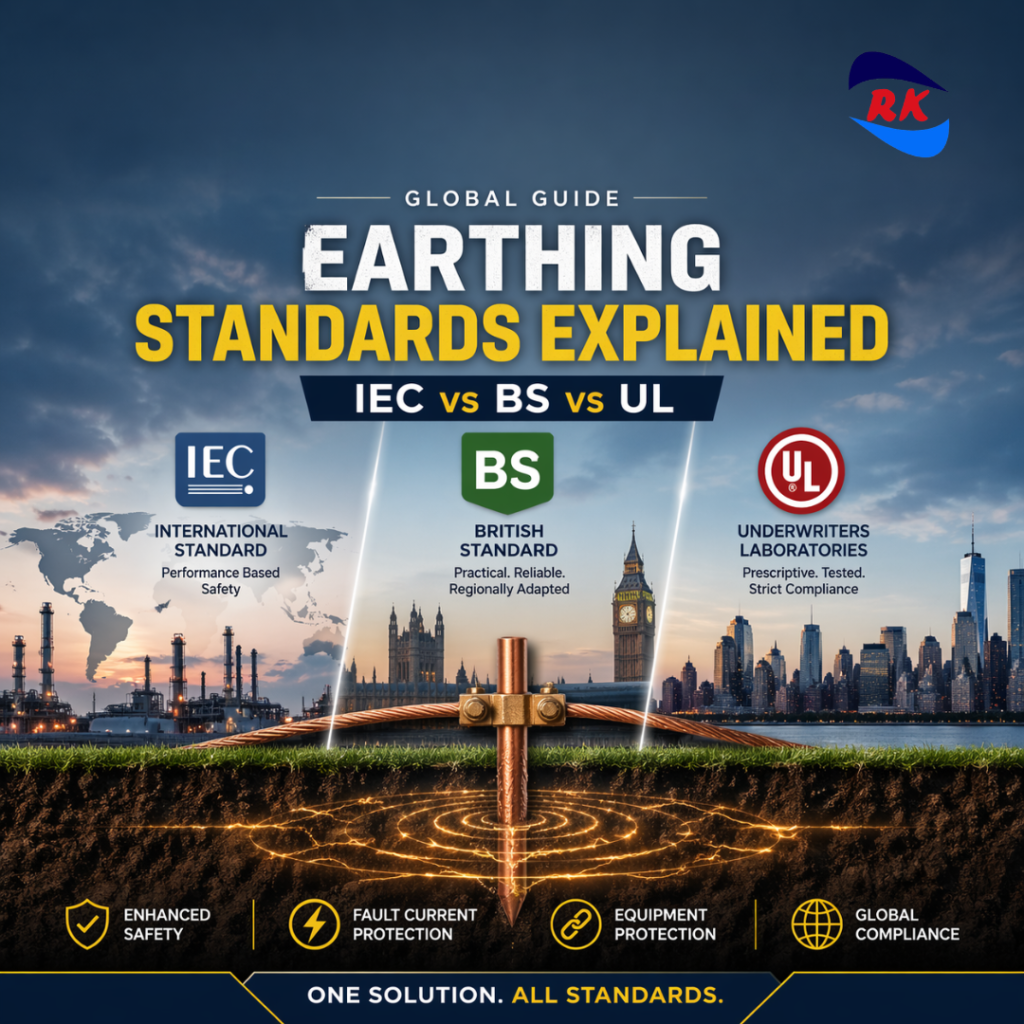
Earthing Standards Explained: IEC vs BS vs UL (Global Guide)
Introduction
Earthing (grounding) is one of the most critical aspects of any electrical system, ensuring safety, equipment protection, and system reliability. Whether in industrial plants, substations, or commercial buildings, proper earthing determines how fault currents flow and how quickly protective systems respond. Internationally, different standards such as IEC, BS, and UL guide the design and implementation of earthing systems, each with its own philosophy and regional relevance.
At RK Engineering, we position ourselves as a top manufacturer delivering globally compliant earthing solutions tailored to meet IEC, BS, and UL requirements. Learn more about our expertise here: https://rkenggindia.com/
Problem Statement
Many engineers and project developers face confusion when dealing with multiple earthing standards across global projects.
- IEC is widely accepted internationally,
- BS is primarily followed in the UK and countries aligned with it,
- UL dominates in the United States and North America.
The challenge arises because:
- Each standard differs in design philosophy and compliance approach.
- Earthing system types and classifications vary.
- Regulatory requirements change based on geography.
Without a clear understanding, improper earthing design can lead to safety hazards, equipment damage, and non-compliance issues. Poor earthing can also increase risks like electric shock, interference, and system instability ().
How We Solve
At RK Engineering, we simplify global earthing compliance by aligning engineering practices with all major standards:
- IEC (International Electrotechnical Commission) Approach
IEC standards (like IEC 60364) classify earthing systems into TN, TT, and IT types, based on how the source and equipment are connected to earth ().
- Focus: Performance-based design
- Widely used across Europe, Asia, and Africa
- Emphasizes safety outcomes rather than strict design rules
IEC systems ensure proper fault current paths, enabling quick protection and minimizing shock risk ().
- BS (British Standards) Approach
BS standards (e.g., BS 7671) are largely derived from IEC but adapted for UK practices.
- Similar earthing systems (TN-S, TN-C-S, TT)
- Focus on practical installation safety and compliance
- Often used in Commonwealth countries
- UL (Underwriters Laboratories) Approach
UL standards are dominant in North America and are more prescriptive:
- Focus: Detailed design rules and testing
- Requires certified compliance and third-party validation
- Specifies exact materials, insulation, and construction methods ()
Unlike IEC’s performance-based approach, UL dictates how systems must be built, ensuring consistency and strict safety compliance.
RK Engineering’s Integrated Solution
We bridge all three standards by:
- Designing hybrid earthing systems compatible with global codes
- Providing customized solutions for export-oriented industries
- Ensuring compliance with IEC, BS, and UL simultaneously
- Delivering tested and certified earthing products
Case Study
Project: Multi-National Manufacturing Plant
A global client required an earthing system that complied with both IEC (for European operations) and UL (for US exports).
Challenges:
- Different grounding philosophies between IEC and UL
- Need for consistent safety across regions
- Certification requirements for multiple markets
Solution by RK Engineering:
- Implemented a TN-S earthing system aligned with IEC standards
- Integrated UL-compliant grounding components
- Ensured low resistance bonding across all metallic parts
- Conducted performance and compliance testing
Result:
- Achieved dual compliance (IEC + UL)
- Improved system reliability and safety
- Reduced project approval time across international markets
Conclusion
Understanding the differences between IEC, BS, and UL earthing standards is essential for any modern electrical project. While IEC focuses on performance, BS adapts it regionally, and UL enforces strict design rules.
Choosing the right approach—or combining them effectively—is key to ensuring safety, compliance, and global acceptance.
RK Engineering stands as a trusted leader and top manufacturer in delivering advanced earthing solutions that meet all major international standards. Whether your project is local or global, we provide the expertise and products needed for safe and reliable grounding systems.